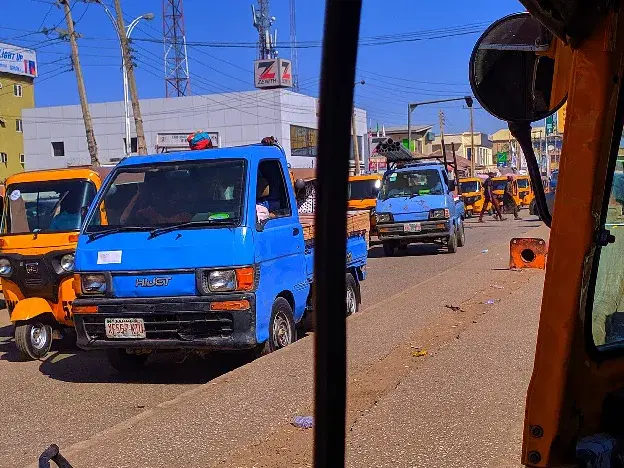
Ask a visitor to describe Abuja and they'll say the same things every time. Wide roads. Clean lines. Roundabouts that look like they were drawn with a compass. A city that was planned.
Now ask anyone who takes public transport in Abuja where their bus stop is.
You will not get a landmark. You will get a description. "Under the bridge." "Before the filling station." "Where they normally stand." "That tree." The stop has no sign, no shelter, no light, no bench, and no name that appears on any map, but three hundred people will be standing there at 6:40am on a Monday morning, and every driver in the FCT knows exactly where it is.
Abuja has bus stops. It just didn't build most of them. Its passengers did.
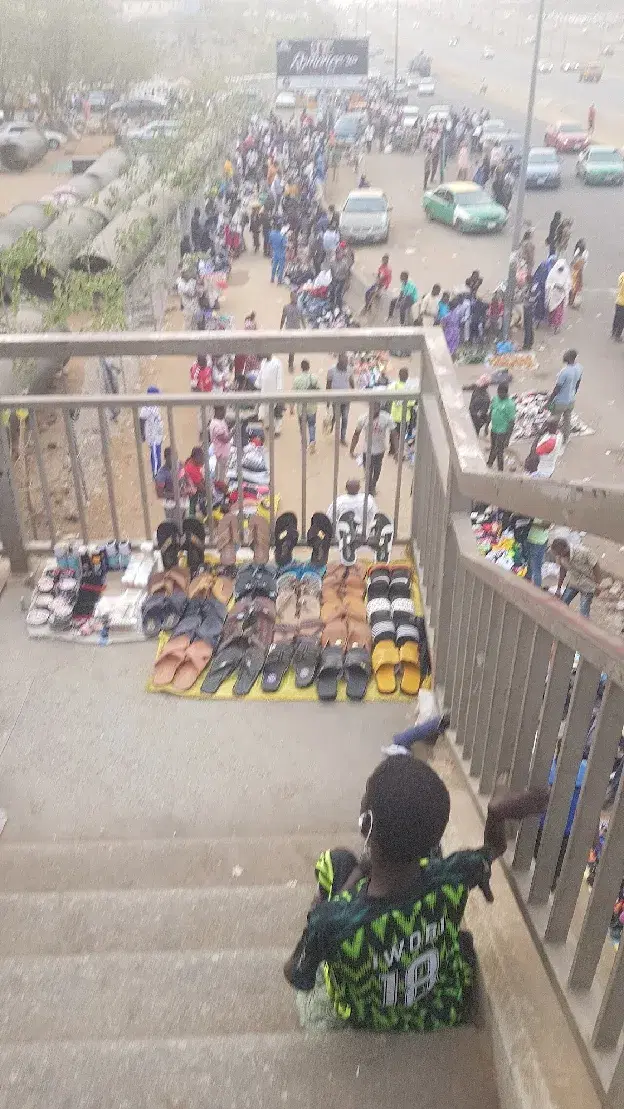
A functioning bus stop with almost none of the things a bus stop is supposed to have. Photo via Wikimedia Commons, CC BY-SA 4.0.
The stops everyone uses and nobody designed
There is an entire unofficial network in this city, and it is remarkably consistent. Coverage running into 2026 keeps pointing to the same congestion hotspots, where commuters gather up and queues stretch well past dark: Berger, Area 1, AYA, Nyanya, Wuse, Gwarinpa, Kubwa and Lugbe. Older reporting on getting around the FCT points to the same struggle on the Mararaba–Nyanya, Kubwa–Dutsen Alhaji–Bwari, Zuba–Suleja and Lugbe–Gwagwalada corridors.
These places do the work of transport infrastructure. They organise the movement of a metro area estimated at over four million people. And most of them offer, in physical terms, nothing at all.
No shelter, so you stand in the sun in March and the rain in August. No seating, so pregnant women, elderly people and anyone carrying anything stand for forty minutes. No lighting, which matters enormously and we'll come back to it. No route information, no fare information, no indication of which vehicles are legitimate. No drainage, so the "stop" becomes a puddle. No pedestrian access, so you cross a fast road to reach it.
A bus stop is not a piece of tarmac where a bus happens to pause. It is a designed object with a job.
What a bus stop is actually supposed to do
Strip it down and a real stop delivers five things:
- Shelter — from sun and rain, because waiting is the majority of the commute experience.
- Information — which routes stop here, where they go, what they cost. The single cheapest intervention available, and the most consistently skipped.
- Safety — lighting, visibility, a clear boundary between waiting people and moving traffic.
- Legibility for drivers — a marked stopping bay, so buses stop there and not wherever the driver decides, which is what causes the swerve-and-brake chaos on Abuja's expressways.
- Dignity — somewhere to sit. Somewhere to stand that isn't a gutter.
Every one of those is cheap relative to a kilometre of road. Abuja has built many kilometres of road.
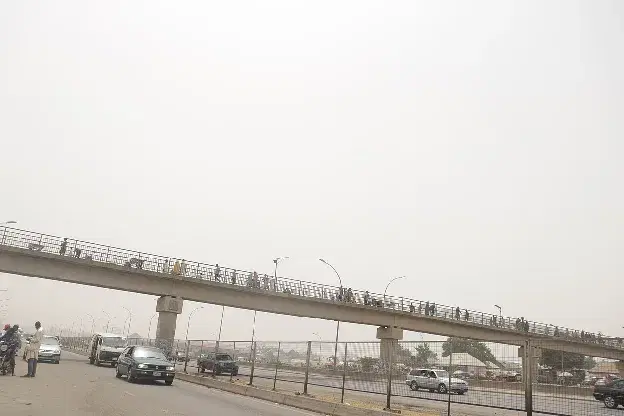
The city invests confidently in road infrastructure. The waiting infrastructure alongside it is where the gap shows. Photo via Wikimedia Commons, CC BY-SA 4.0.
The dark stop problem
This is where the missing infrastructure stops being an inconvenience and becomes a safety issue.
"One chance" — the robbery pattern where criminals pose as drivers and passengers to prey on commuters — is one of the FCT's most persistent security problems. In 2026, the Nigeria Police Force published details of an 18-month investigation that dismantled a syndicate accused of robbing, kidnapping and extorting dozens of Abuja commuters. Reporting through 2025 and 2026 has documented deaths.
The link to infrastructure is direct, and security analysts have made it explicitly. Reporting in mid-2026 tied the surge to the transport squeeze itself: gridlock, shrinking vehicle supply and overcrowded junctions leave people stranded at unlit spots in the evening, and police sources identified poor street lighting and traffic hold-ups as conditions criminals exploit to lure desperate commuters into unsafe vehicles.
Put plainly: a lit, marked, supervised bus stop where only registered vehicles pick up is not a beautification project. It is a crime prevention measure.
What's actually changing right now
Something is finally moving, and it's worth understanding precisely what it is — and what it isn't.
In August 2026, the FCT Administration announced the operationalisation of new ultra-modern bus and taxi terminals at Mabushi, Kugbo and the Central Business District. Officials described them as the first facilities of their kind in the FCT's roughly fifty-year history, built under a public-private partnership arrangement.
Alongside that came enforcement. The Transportation Secretariat's mandate secretary, Chinedum Elechi, directed operators using illegal parks and roadside loading points to relocate or face shutdown, warning that unauthorized loading points would be closed and non-compliant vehicles impounded. The secretariat says it has the legal authority to license operators, seal premises and prosecute, and it has framed the exercise partly as an anti-"one chance" measure, arguing that profiling operators at approved terminals improves security. Officials pointed to Oshodi in Lagos as proof that a chaotic hub can be transformed, and said more terminals are in the pipeline.
The functional split matters: the CBD terminal is aimed mainly at intra-city commuters, taxis, e-hailing and feeder buses, while Mabushi and Kugbo focus on intercity travel.
The gap the terminals don't close
Here is the honest caveat, and it's a big one.
A terminal is not a bus stop. Three terminals serve three locations. The daily commute of an FCT resident involves a stop near their house in Kubwa or Lugbe or Nyanya, and a stop near their office in Wuse or Garki or Maitama. Neither of those is Mabushi.
If roadside loading is banned but the network of legitimate, sheltered, lit stops isn't built out across the corridors people actually live on, the enforcement squeezes supply without replacing it, and the people who suffer first are exactly the people already standing in the dark at 8pm. The FCTA has said more terminals are planned and funded through future budgets. The test is whether "more terminals" also means many more small stops, which is a different and much cheaper category of thing.
The other missing piece is the last mile. The Abuja light rail exists — 42.5 km, 12 stations across two lines, relaunched in May 2024 after years of dormancy — but analysts note it has struggled to absorb rising demand because of limited coverage and thin schedules. A rail station only works if you can get to it, and getting to it means a stop, a feeder route, and a walkable path.
The cheap version of a good idea
You do not need another mega-project to return most of that dignity. You need six unglamorous things, in roughly this order.
1. Name the stops. Map the informal network that already exists — it's stable, everyone knows it — and give each stop an official name and a sign. Cost: negligible. Effect: immediate. A named stop can be given as an address, searched on a map, dispatched to, complained about, and budgeted for. Nothing that has no name ever gets fixed, because it doesn't appear on any list. Who: FCTA Transportation Secretariat, with area councils. Timeline: months, not years.
2. Light them. Solar streetlights at the top 50 stops by footfall, starting with the ones on the Nyanya–Mararaba, Kubwa Expressway and Airport Road corridors. Police sources have specifically identified poor street lighting as one of the conditions criminals exploit to lure stranded commuters into unsafe vehicles. This is a crime intervention wearing the costume of a lighting contract, and it costs a rounding error against a road project. Who: FCTA, or private sponsors under a named "adopt-a-stop" scheme. Timeline: one dry season.
3. Shelter them. A roof and a bench. Not a terminal — a shelter. Rain cover, shade, and somewhere for a pregnant woman or an elderly passenger to sit. This is the single intervention that changes how the commute feels, and it is the one most likely to be dismissed as cosmetic by people who have never waited forty minutes in August rain. Who: FCTA capital budget, or advertising-funded shelters — the model that pays for bus shelters in most of the world.
4. Post the route and the fare. A printed board listing which vehicles stop here, where they go, and what the fare should be. This ends the daily negotiation, and it removes the information advantage that touts and "one chance" operators rely on. A passenger who knows the correct fare and the correct route is much harder to disorient. Add a painted phone number for reporting — the FCT police already run an anti-one-chance unit, and LAMATA in Lagos has shown that published complaint lines change behaviour. Who: FCTA, in partnership with transport unions who benefit from fare disputes ending.
5. Mark the bay. Paint a stopping bay so buses stop in one predictable place instead of swerving across three lanes wherever a passenger raises a hand. This is paint, and it fixes both safety and the accordion-braking that helps create the congestion in the first place. Who: FCTA and VIO/traffic enforcement — worthless without enforcement, which is the actual cost.
6. Feed the rail. Cluster the stops and short feeder routes around light rail stations so the city starts getting value from an asset it has already paid for. The Abuja Rail Mass Transit's first phase cost in the region of US$824 million, largely financed by Exim Bank of China loans that are already being repaid. It runs 42.5 km across 12 stations, and analysts note it still struggles to absorb demand because of limited coverage and thin schedules. A station nobody can reach on foot or by feeder bus is an expensive monument. A station with three feeder routes into Kubwa's estates is a transport system. Who: FCTA plus licensed operators, using the new terminal licensing regime as the lever.
And the part that doesn't have to wait for government
Some of this can start without a single approval, which is worth saying out loud:
- Employers running staff buses from satellite towns take pressure off the corridor and get their people to work intact. Reporting has noted that the early-morning scramble is measurably easier where company buses run.
- Estate and residents' associations in Kubwa, Lugbe, Gwarinpa and Lokogoma can fund a shelter and a solar light at their own gate faster than any procurement cycle. Many already fund security and boreholes; this is the same instinct applied to the thing residents use every day.
- Banks, telcos and FMCG brands already pay for outdoor advertising. A branded shelter with a route board is cheaper than a billboard and does something for the people looking at it.
- Transport unions have the route knowledge nobody else has. The informal map exists in their heads. Formalising it costs them nothing and protects their members from the impoundment regime now in force.
- Residents can do the smallest and most underrated thing: document the stops. Photographs, names, footfall counts, a shared map. Advocacy without data gets ignored; advocacy with a spreadsheet occasionally doesn't.
Sources: TheCable, Daily Post, Voice of Nigeria, Peoples Gazette, Leadership and The Sun on FCTA terminal operationalisation and enforcement against illegal parks (August 2026); Premium Times and HumAngle on "one chance" in Abuja; New National Star on transport pressure, hotspots and light rail capacity; Daily Trust and Blueprint on FCT commuting and bus stop congestion; Wikipedia/Abuja Light Rail for system specifications; Daily Trust (2026) for FCT population estimate.